

This past weekend I gave a team of agents and models a job with my name on it, literally: build my personal site, and see if I could trust the result. It’s live now at lilyluo.ai, and I’m pretty happy with it.
Through my own builds, and from others in this space, I've come to think that trust in what an AI agent produces doesn't necessarily come from the model being smart enough. It comes from the structure around it: audits, reviews, appeals, the same machinery organizations already run.
I wanted to run that structure on my own use case and see what it actually did for me, with the goals of fewer hallucinations, less of my own steering, better output, and lower cost, without reaching for the most expensive model every time. I also wanted to learn which model to map to the task.
Fable 5 is Anthropic’s most capable model, and the best performing model I have used. It’s also the most expensive to run, so I used it for the strategy and orchestration pieces, and I routed everything else to cheaper models and to my own agents. The output was better than what I get running one model straight through, and it cost a fraction as much. (Fable 5’s writing also reads a bit more stilted than Opus to me, which is one more reason I wanted separate voice checks.) I’ve written before that the model is about 20% of the system and the harness is 80%. This experiment adds two things to that equation: cost, and matching each task to the right model.
Context for new readers: for months I’ve been running three autonomous agents around the clock on my own DigitalOcean instance (a cloud server), for about $6 a day total. Atlas holds my voice and memory files and coordinates the others, Sift researches, and Vigil monitors the infrastructure. I communicate with them via Discord, and the group named itself “The Pod.”
Matching the task to the model
I split the work across four tiers.
Fable 5, running in Claude Code (Anthropic’s coding tool that works in a terminal and can edit files and run commands directly), did the expensive, strategic work. It orchestrated the build, drafted the copy and the code, produced three design mockups from three competing briefs, created the multiagent review panel including a bridge to Discord for my own agents, and later took over my browser to put the site live. Premium dollars for premium work.
DeepSeek, Kimi, and GLM (three other providers’ models, much cheaper to run) did the reviewing. They ran the fact-checking, the sensitivity review, the voice checks, the design judging, and three focus-group personas.
My own agents reviewed with something none of the others had: my history and context. Atlas holds my identity and memory files, so it could judge whether a page actually sounded like me, not just whether the grammar was correct.
Me. I kept two jobs: the rulings, and anything that needed a password.
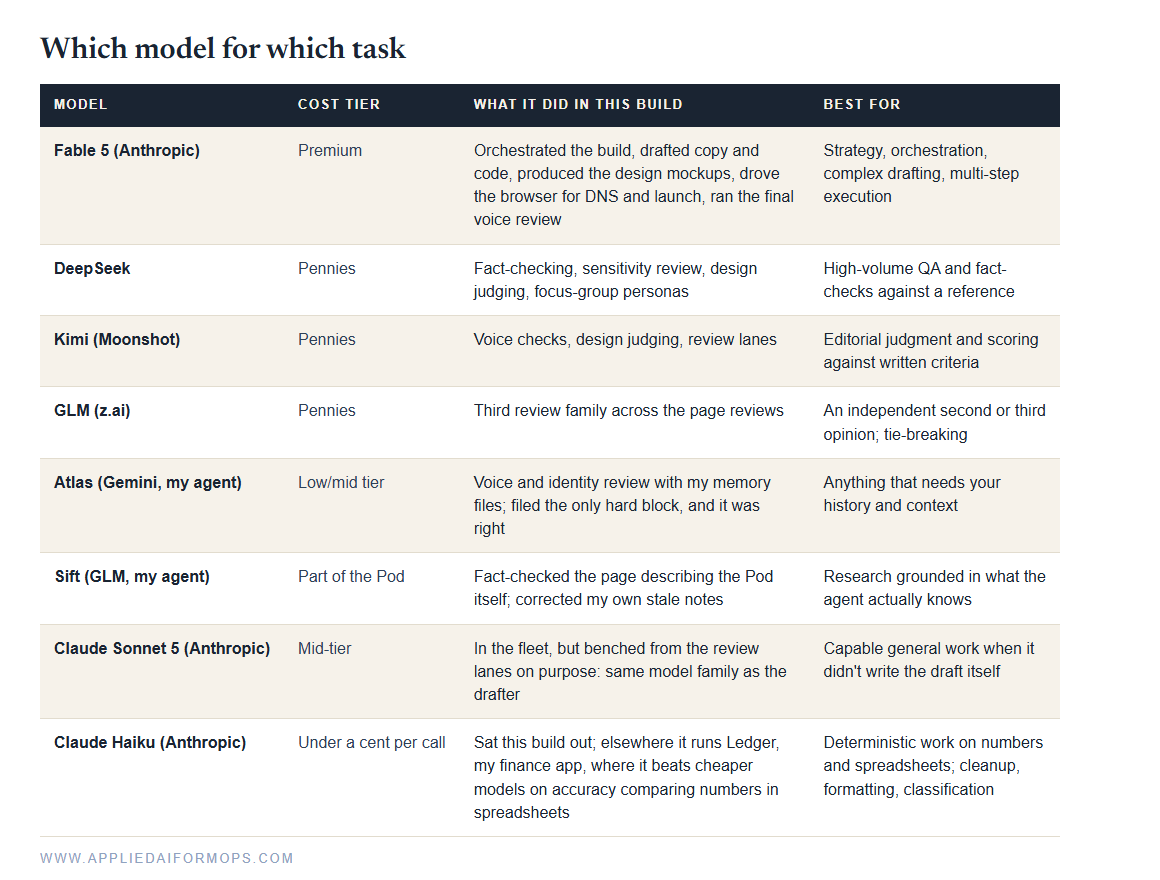
One rule I implemented was that the model that wrote a draft never reviewed it. Drafting and reviewing were different models on purpose: a model that didn’t write the draft catches things the drafter can’t see, and it doesn’t need to be the expensive one to do it well.
Every verdict came back as a small file documenting who reviewed it, which model, the timestamp, the exact quote it flagged, and the priority. When an agent flagged something, I read the information and made the judgment call.
What the agent reviewers caught
Atlas and the Pod hold my memory files, which made them the reviewers that could judge whether the About page sounded like me. Atlas’s verdict:
verdict: revise. the hook and the “adoption beats sophistication” line are incredibly strong, but “couldn’t have told you what Python was” feels like a cliché underdog trope for someone who was already a highly technical systems thinker. everything else captures her voice perfectly.
Sift fact-checked the page that describes the Pod itself, so the system under review was reviewing its own description. It passed accuracy and sensitivity, and it flagged that the section undersold what’s actually there. It also corrected the record: my own notes had the Pod’s model lineup out of date, and the agent knew better than I did.
Another catch was on the homepage. Out of roughly 100 verdicts filed during this build, the only “hard block” came from my own agent, about my biography:
verdict: block. the timeline math is completely broken: claiming “nine months ago” she didn’t know python, but writing first code “less than two years ago,” and winning builder awards “three years running” is a massive ai hallucination loop. we need to lock down a single, physically possible timeline before this goes anywhere near a public launch.
It was right. “Nine months ago” was a line from my own portfolio, true when I wrote it in February, and the awards weren’t exactly three years running. On the second round, on the corrected website copy, Atlas found another problem. Only the 2025 award was for building AI workflows, and the copy had let my AI systems take credit for wins that predate me using AI. Round three passed. Atlas runs on pretty much the same class of model the other agents do, but the difference wasn't the model, it was the months of memory and context sitting behind it.
Where I still had to steer
The reviews ran with almost no attention from me. While the project still needed me at specific moments, the steering moved up a level, from correcting sentences to making rulings.
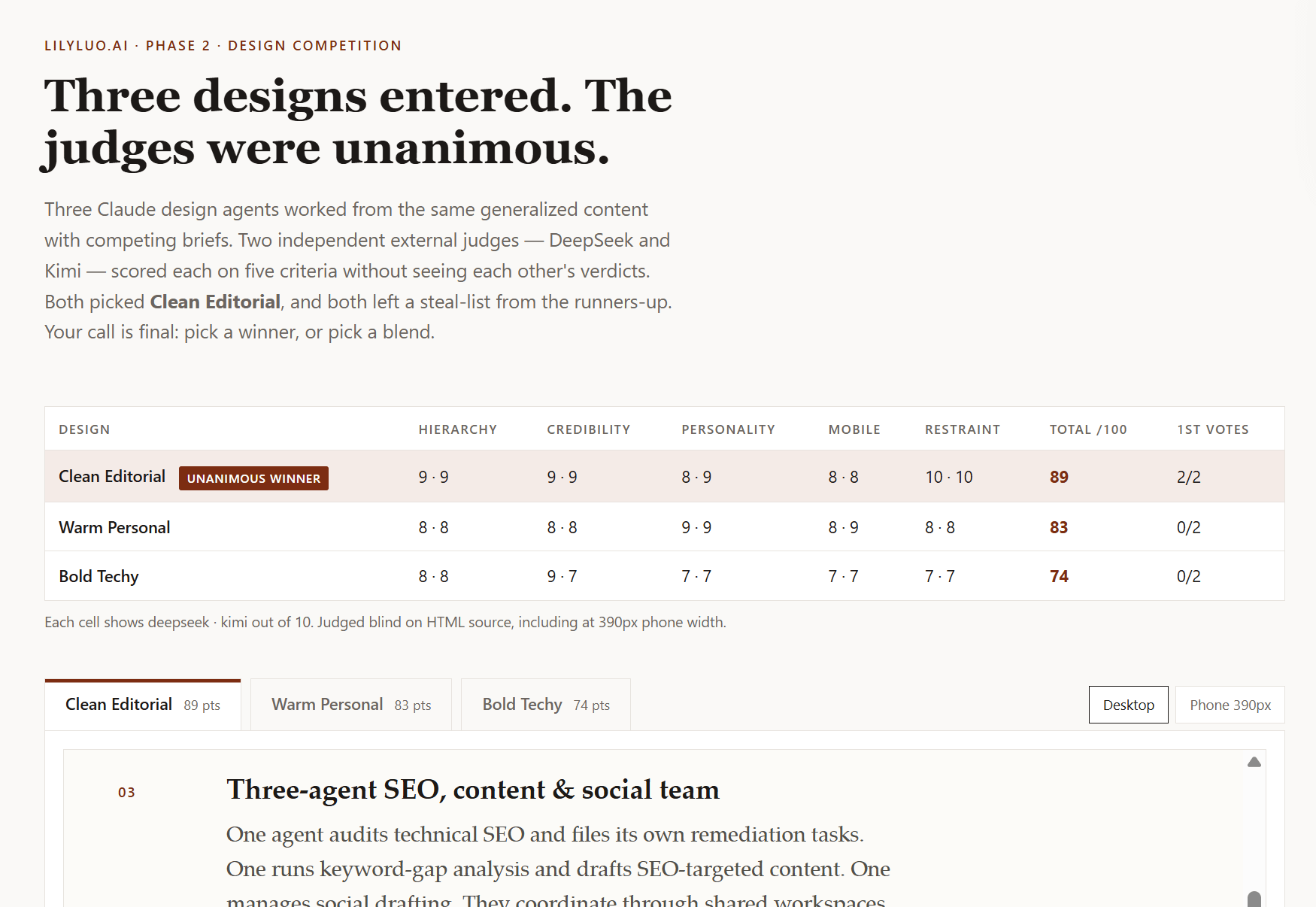
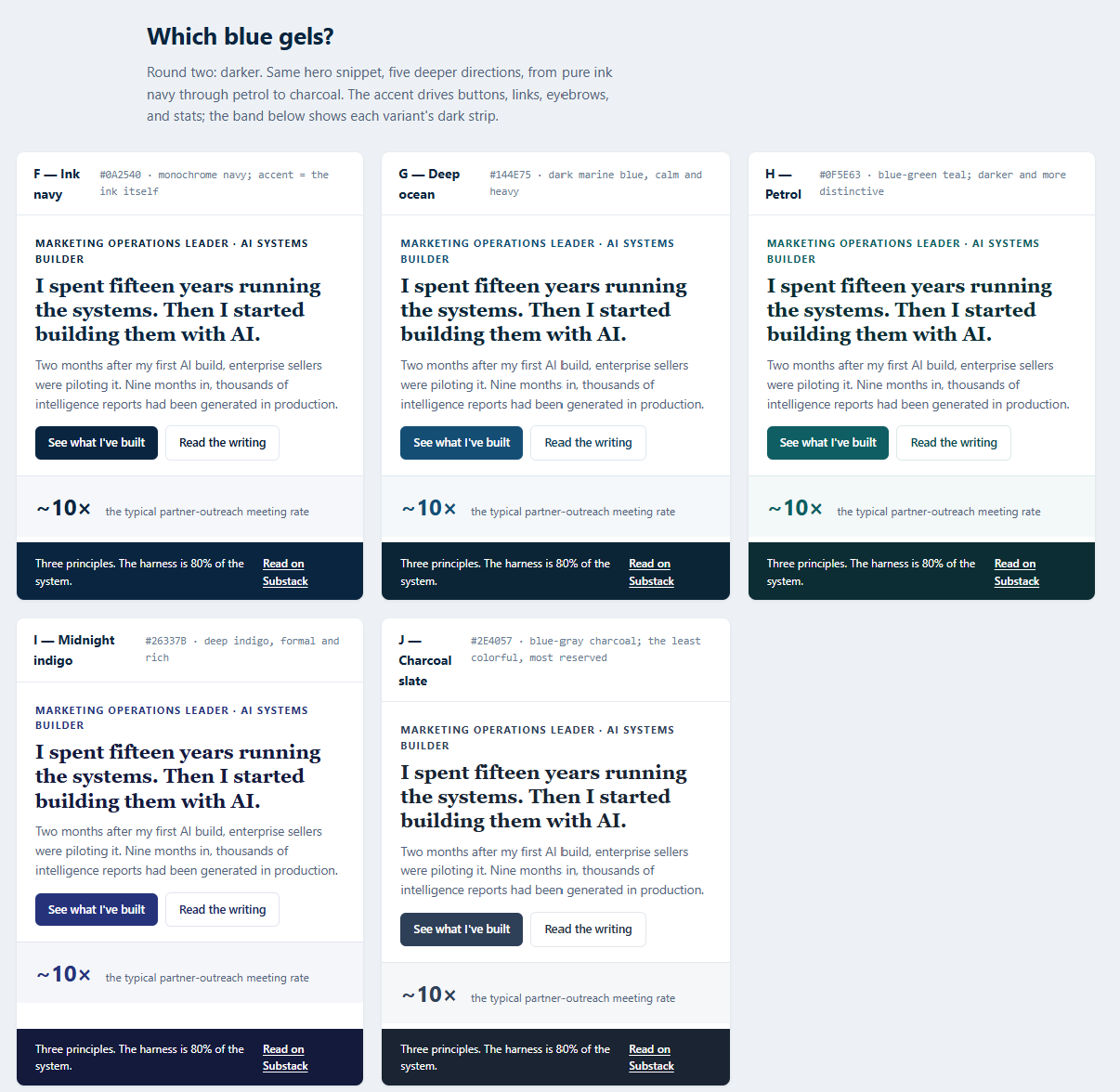
The design competition for my website went to a blind panel. DeepSeek and Kimi scored five criteria and agreed: the clean editorial mockup won 89 to 83 over the warm, personal one. I launched the warm one anyway, because that decision was about my own preferences and identity. I also overrode the palette a few times. The first version came out too Claude-colored, so I picked one I liked most from a prototype page the agents built me with color schemes and typefaces side by side.
Design panel:
Palette and typeface review:
At the end of the workflow, Fable 5 read every page against my written voice rules and brought me fourteen numbered findings: grammar slips, a subject that didn’t agree with its verb, a word from my own banned list. I answered all fourteen in one message, approving some, redirecting others. Each answer became an edit, and the reasons became new rules in my voice file, so the next draft starts from an improved baseline.
And when I wanted to edit the words myself, the agents built me a local editor where every sentence on the site is a form field, so I can rewrite copy without opening code.
With this workflow, the work didn’t necessarily disappear, but just changed its shape. I spent my time ruling on decisions instead of fixing commas or dictating changes line by line.
When it came to actually launching the website, the setup that’s usually the most difficult is the last mile. It’s also the one part where the cheap reviewers can’t help as much: the domain, DNS, and verification steps were much faster with the capable model. This time I handed my computer to Fable 5 in Claude Code and watched it work. It took over my browser, found the domain settings in Vercel (the hosting platform), edited the DNS records at my registrar, verified the site with Google Search Console, and submitted the sitemap. I didn’t touch the keyboard except when it asked me to.
Every time a login or a verification prompt came up, it stopped and handed control back, which made things really easy for me, and the authentication stayed with me.
What it cost
So how much did this whole project cost? The roughly 100 reviews across three model families came to under $2, since I was using the cheaper models.
Fable 5 did the expensive work. I actually ran through my Max plan's usage for it, but that was because I had several sessions going at once, building productivity tools and apps too (more on those in a later post). For this project specifically, the overage was probably $5 to $10.
As far as the actual website, hosting is $0 on a free tier, and every future edit deploys on its own when I (or Claude Code) push it. The domain, lilyluo.ai, was the big line item at about $170 for two years.
The verdict
The site is live, it cleared my quality bar after the review rounds, and it sounds like me. I cut my own steering from an afternoon of line-editing down to a handful of written rulings and an hour or so updating copy via the editor. And I did it without running my most expensive model on every step. Fable 5 did what Fable 5 could do, the cheaper models did the checking, my own agents did the part that needed my history, and I did the part that needed my own judgment.
The whole project is smaller than it sounds — roles are markdown files, verdicts are small records and files you can reread later, appeals are written next to the decisions they overrule. The only information I had to gather was context, and I already had most of that.
If you want to try a version of this, start with one small thing. Take a cheaper model (free version is fine) that didn’t write the draft and have it check the draft against a rule you care about. Save the verdict where you can read it later and track which model does well at specific tasks. I’ve packaged up how you can try this as a one-page starter kit: follow it by hand in a chat window, or paste the file to your AI tool and say “set this up for me.”
Next I want to point this same setup at the tools I build for my own machine, starting with voice dictation. More on that soon. And check out my live website at lilyluo.ai.
Would love to hear how you’re splitting work across models, and how you decide when to trust what comes back!
This is awesome, and I think it's also where best practices are headed as token economics become more top of mind across the field. Not every action needs the same level of intelligence. We're exploring this as well.
Congrats on the new site! Great idea and looks fantastic.